
Preparing for the Skills and Growth Reforms: What employers should know about supporting young people into work

Preparing for the Skills and Growth Reforms: What employers should know about supporting young people into work
The UK’s apprenticeship and skills system is entering a major period of change. With new Skills and Growth Reforms on the horizon, it’s vital that employers, especially those delivering public services or bidding into the UK public sector, understand what’s coming and how it affects their workforce, social value delivery, and future talent pipeline.
Across the UK, almost one million young people aged 16–24 are NEET (Not in Education, Employment or Training). That’s around one in eight, and the government has made it clear: getting young people into meaningful work is now a national priority.
Why the System is Changing
Over the past decade, apprenticeship starts for young people have fallen by 40%. A significant proportion of levy funding has been used for older workers or employees with substantial prior learning or experience. The new government has committed to “pivoting” the system back towards younger learners, especially school and college leavers, while still protecting training pathways that address critical national skills shortages highlighted in the UK Industrial Strategy.
Funding remains available for adults who need to upskill, retrain, or enter the workforce for the first time, but this will look slightly different (We’ve produced a separate guide covering adult training options.)
This article focuses on helping employers prepare for the reforms we know about so far, and plan ahead for the changes still to come.
Training and Employment Options for Young People (16–24)
Young people now have access to a broad mix of technical, vocational and work‑based pathways. Understanding these routes is essential for employers wanting to create opportunities, meet social value requirements, and build a long‑term talent pipeline.
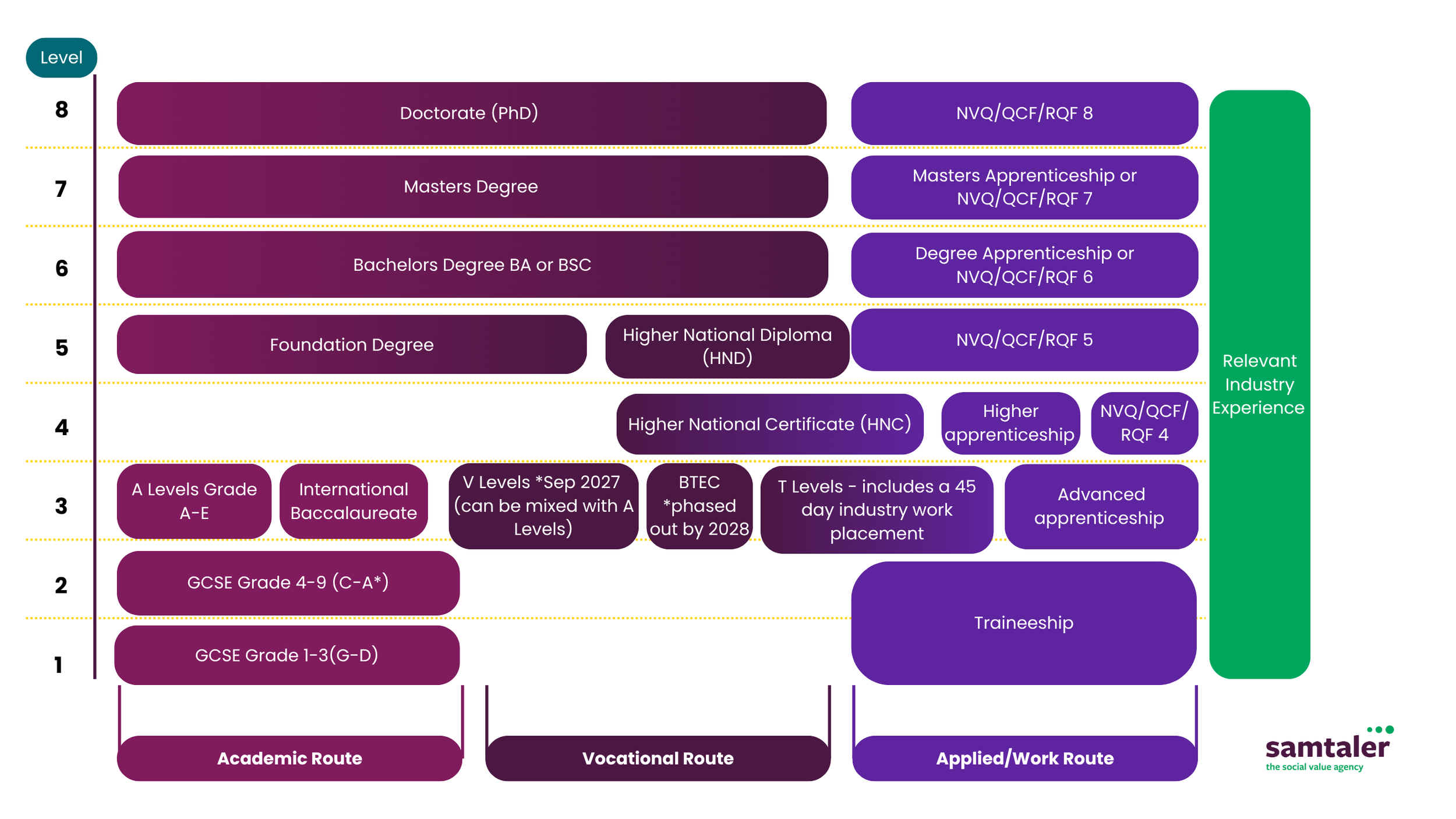
1. Apprenticeships and Work-Based Learning
Apprenticeships (Level 3–6)
For anyone aged 16+, apprenticeships remain a core work‑based route. These offer a practical way for employers to attract and train new talent and deliver measurable social value outcomes.
Apprentices earn a wage while training and complete real work for their employer
Minimum duration reduced to 8 months where appropriate as part of reforms.
Pathways available from Level 3 (A Level equivalent) to Level 6 (degree level).
Pathways span industries: Early years, rail, digital, sustainability, insurance, engineering, just to name a few.
Foundation Apprenticeships (Level 2)
Aimed at 16–21-year-olds (extended to 24 for care leavers and EHCP holders) and lasting eight months, these programmes:
Focus on key employability skills and job‑specific knowledge.
Help young people transition confidently from education to work.
Are available in construction, digital, engineering, and health
And are expanding, with new options in catering, hospitality, retail (from Apr 2026) and business administration (from Aug 2026).
Level 7 (Master’s) Apprenticeships
From January 2026, levy funding for Level 7 apprenticeships will be limited to those aged under 22, or under 25 with an EHCP or care‑experienced background. It’s unclear how much this will reduce access to L7 apprenticeships as few under 22 will meet the prior qualification requirements.
2. Technical and Vocational Qualifications (Level 3)
Government reforms are creating a clearer post‑16 landscape with varied “gold standard” routes. These include more well-known routes such as A Levels and Apprenticeships, in addition to more recent developments T-Levels and V-Levels.
T Levels
For 16–19-year-olds, these two‑year technical programmes include:
A mandatory 45‑day industry placement (315 hours).
A strong pathway into apprenticeships or further technical training.
Employers offering placements often find themselves with a talent pipeline into degree apprenticeships with higher success and retention, as those who have completed a T Level placement better understand the work and the career they are embarking on.
V Levels (Launching Sep 2027)
A flexible vocational qualification the size of one A Level (360 hours). Learning will be designed around real jobs and the skills employers actually need, to help young people secure well-paid jobs and fill skills gaps. Learners will be able to:
Mix and match with A Levels.
Explore multiple sectors before specialising.
Study subjects including: Education, finance, and digital (from 2027); construction, sales marketing and procurement, exercise science (from 2029) just to name a few.
This offers a practical new way for employers to engage early with potential talent and they should look out for opportunities to consult on V Level courses.
3. Youth Employment Schemes and Incentives
The Skills and Growth Reforms also include financial support for employers to help young people into work.
Jobs Guarantee Scheme
For 18–24-year-olds, offering:
A six‑month government‑funded work placement
25 hours per week at minimum wage
No cost to the employer
Apprenticeship incentives
SMEs can claim a £2,000 incentive for each new apprentice hired between the ages of 16 and 24
Youth Jobs Grants
Employers are eligible for a £3,000 grant for hiring a young person (aged 18-24) who has been on Universal Credit and looking for work for at least six months
In many cases, eligible businesses can claim both the £3,000 youth jobs grant and the £2,000 apprenticeship incentive simultaneously
Fully funded training for SMEs
From August 2026, the government will fully fund apprenticeship training for under-25s at non-levy-paying businesses (mostly SMEs).
4. Why these reforms matter
We believe these reforms offer genuine benefits for young people, employers and the UK workforce. To stay competitive and meet public sector expectations, employers need diverse entry routes that:
Reflect different learning styles
Provide clear technical and vocational pathways
Support long-term career progression
Strengthen diversity of thought and innovation
Traditional academic routes alone cannot meet the needs of a modern workforce. A mix of options is essential.

5. Limitations
Disruption of the jobs market
The government is investing £2 billion+ into the UK’s AI ecosystem (2026–2030). While this is expected to boost productivity, it is also expected to reshape the labour market particularly entry-level roles, which are often the first subject to automation. This shift cannot be overlooked in the reforms.
Entry-level roles are crucial. They create a job right now, but also build a future workforce of leaders and technical specialists. Without strong entry routes, the UK risks deepening future skills shortages.
The Wider Challenges Affecting Young People
1 in 8 young people (16–24) are NEET (Not in Education, Employment or Training) which can’t be explained by training system design alone. Young people face complex barriers which limit entry into employment. We have summarised just a few using the stats below:
30% of 11–16-year-olds with probable mental health conditions missed a week or more of school in 2023 (compared to 10% of their peers without a mental health condition)
35% of 18–24-year-olds in work have taken time off due to mental health or stress.
More than 78,000 young people waited over a year for NHS mental health support in 2023/24.
90% of young people worry about earning enough to live independently due to the cost of living in the UK
Unpaid or low‑paid training routes are simply unaffordable for many.
To make the reforms work, employers and policymakers must consider not just training routes, but the wraparound support young people need, including financial support during learning and access to timely mental health services.
6. What Employers Should Do Now
To prepare for the Skills and Growth Reforms, employers, particularly those bidding into UK public sector contracts, should:
Review early careers pathways and align them with new youth-focused funding rules
Expand Level 2 and Level 3 opportunities to attract diverse talent
Offer T Level placements to create future talent pipelines
Strengthen mental health and pastoral support for young employees
Reflect youth employment commitments in social value strategies and tender submissions
Engage with local partners (e.g., schools, colleges, youth organisations) to widen access
These steps will help employers meet both workforce needs and social value requirements under the Social Value Model.
What’s Next?
Visit our Apprenticeship & Skills resource page here
At Samtaler, we understand the importance of social value to help businesses become better and stronger. To find out how we can help send an email tohello@samtaler.co.uk or complete our contact form