
Skills and Growth Reforms: What employers should know about upskilling and reskilling their existing adult workforce

In our last post, What employers should know about supporting young people into work, we explored the Skills and Growth Reforms and what they mean for those aged 16–24 entering the workforce.
If you read that and found yourself thinking “But what about those already in work?” - don’t panic!
While the government’s reforms are clearly designed to rebalance the system towards younger learners, adult training has not been forgotten. In fact, the changes create new, more flexible ways for employers to invest in their existing workforce, respond to skills shortages, and prepare for the impact of AI and the green transition.
The phrase “you never stop learning” has never felt more relevant. For employers navigating rapid technological change, skills shortages and increasing public sector expectations, upskilling, reskilling and crossskilling adults is a strategic priority.
This article focuses on what’s changing and how employers can maximise the opportunities.
Why adult skills matter
Most organisations already understand the value of:
Upskilling – helping employees progress in their current role
Reskilling – supporting people to pivot into new roles or career pathways
Cross‑skilling – building capability across different functions to increase flexibility
These approaches help organisations remain competitive, resilient and productive. They also support staff retention, strengthen internal talent pipelines, and represent excellent social value commitments.
They are especially important given the accelerating influence of artificial intelligence and automation, which are already reshaping job roles across every sector from professional services and construction to energy, transport and public services.
The Skills and Growth Reforms introduce new mechanisms that make adult learning faster, more targeted and more accessible for employers.
Apprenticeship Units: a new flexible option for adult upskilling
One of the most significant developments for adult learners is the launch of Apprenticeship Units, introduced in April 2026. These units sit alongside traditional apprenticeships but are designed for rapid, focused skills development and are specifically designed for employed learners aged 19+.
These short, flexible courses last 1 to 16 weeks with between 30 and 140 hours of delivery. They are funded through the Skills and Growth Levy and fully funded by the gov for non-levy paying employers.
There is also no fixed percentage cap on how much levy funding employers can use for apprenticeship units. A huge shift, giving employers far more freedom to use levy funding to address immediate skills gaps, rather than committing staff to long, full apprenticeship programmes.
The initial rollout of Apprenticeship Units (April 2026) includes:
AI Leadership (developing and leading AI strategy)
Battery Manufacturing (Level 2)
Electric Vehicle charging point installation and maintenance
Solar Photovoltaic (PV) installation and maintenance
Welding (mechanised)
Electrical fitting and assembly
Mechanical fitting and assembly
Permanent modular building assembly
For employers delivering public services or bidding into public sector contracts, these units could represent clear, measurable social value commitments linked to in-work progression and skills development.
Changes to traditional apprenticeship funding:
The reforms also include changes to traditional apprenticeship standards. From September 2026, funding will be withdrawn from 16 apprenticeship standards where the government believes training should be treated as general professional development for employees aged 25+. This includes Level 3 Team Leader; Level 5 Operations Manager; Level 6 Chartered Manager.
These programmes can still be delivered but will need to be employer-funded if they remain important to your organisation.
However, many apprenticeships remain available to learners of any age, particularly those that address technical and emerging skills shortages. This includes new apprenticeship standard: AI and Automation Practitioner (Level 4). This is an 18-month programme, relevant to all sectors, designed to support the safe and effective adoption of emerging technology.
This sits alongside the AI Leadership Apprenticeship Unit and forms part of a broader national push to build AI capability across the workforce.
Skills Bootcamps: a fast route to recruitment
For employers looking to recruit new staff in specific areas, rather than train existing employees, Skills Bootcamps offer another route.
For 2025-26, the government has earmarked £132 million for priority sector bootcamps (aiming for 40,000 learners) and an additional £100 million for construction-specific bootcamps. Demonstrating the emphasis and pipeline that stands to come from bootcamps.
Skills Bootcamps are:
Intensive, flexible training programmes lasting up to 16 weeks
Open to adults aged 19+
Designed to prepare people for specific job roles
Available across hundreds of sectors
Courses are available in areas including:
Digital (software development, data engineering)
Construction and engineering
Green skills (EV maintenance, heat pumps)
HGV driving
Early years and care
Employers who hire in these area should consider offering guaranteed job interviews and using Skills Bootcamp for their talent pipeline. This route offers access jobready candidates and allows employers to support people into work without needing to deliver training themselves.
AI Skills Boost: building baseline AI capability
Alongside formal training routes, the government has launched the AI Skills Boost, a national initiative aiming to upskill 10 million workers in AI by 2030. The site offers:
Free online AI courses for every adult in the UK
Developed with major tech companies including Google, Microsoft and Amazon
Short, practical modules (some take as little as 20 minutes)
Focused on everyday workplace tasks such as drafting content, analysing data and automating admin
Learners receive a virtual AI Foundations badge
This initiative complements both the AI Leadership Apprenticeship Unit and the Level 4 AI and Automation Practitioner apprenticeship, helping employers build AI capability at multiple levels.
What employers should do now
To make the most of these reforms, employers should:
Review how levy funding is currently used
Identify roles where short, targeted training would add immediate value
Consider Apprenticeship Units for AI, green skills and technical roles
Consider Skills Bootcamps as part of recruitment strategies
Factor adult upskilling into workforce planning and social value strategies
Align training investment with future skills needs, not just current job roles
For organisations delivering public services, these reforms could form excellent social value commitments in upcoming tenders, particularly around in-work progression; skills for growth and tackling inequalities.
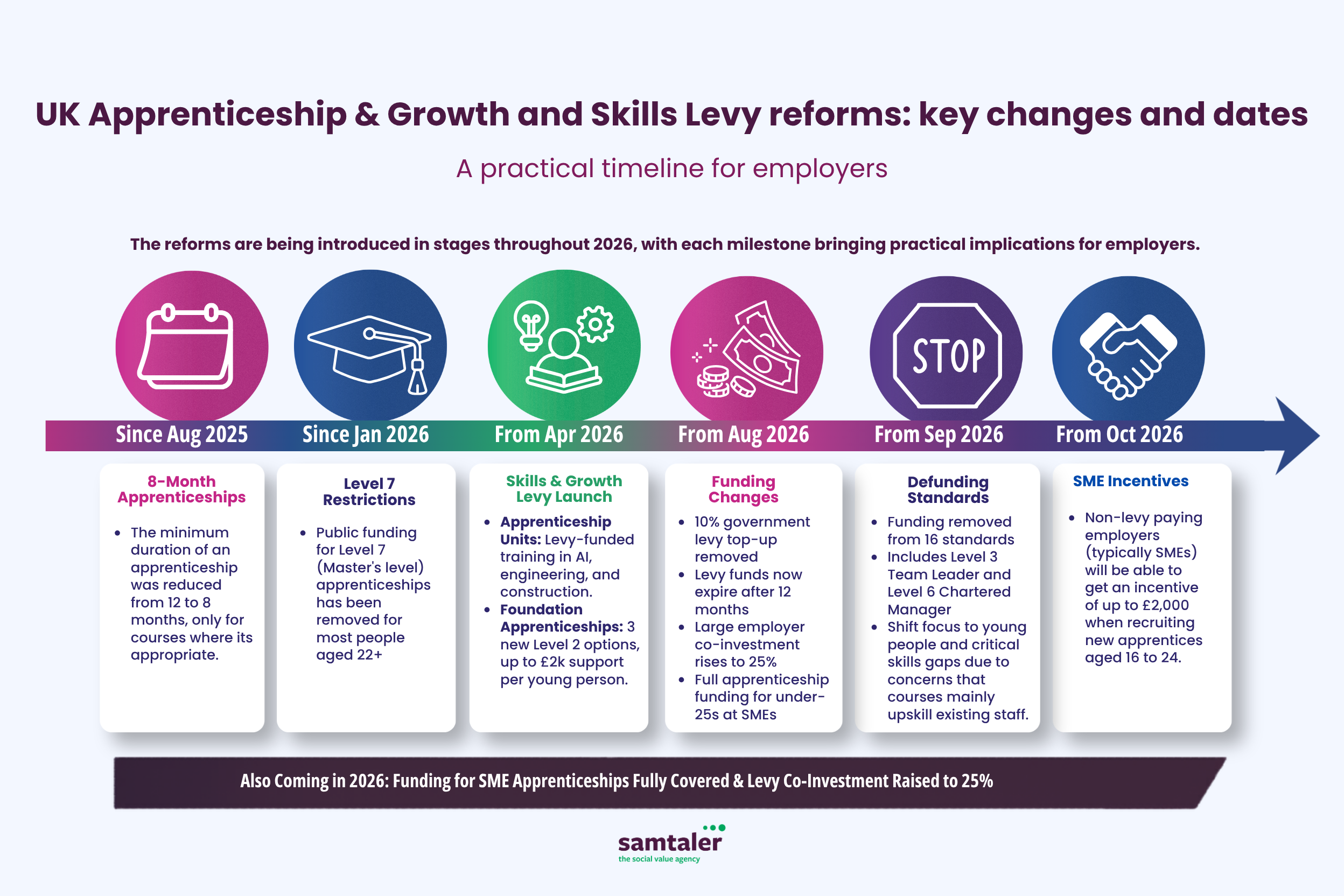
Click to download
What’s Next?
Visit our Apprenticeship & Skills resource page here
At Samtaler, we understand the importance of social value to help businesses become better and stronger. To find out how we can help send an email tohello@samtaler.co.uk or complete our contact form