
Social value, ESG and CSR: What’s the Difference?

Let’s face it, sustainability can feel like alphabet soup!
From CSR to ESG to SV, there’s no shortage of acronyms and overlapping jargon. Even for those working in the field every day, these terms can mean different things to different people.
We’ve taken a stab at demystifying some of the main terms we come across, and how they differ (even though they’re sometimes used interchangeably). This is just the start of the conversation, so tell us, do you use one of these terms or a different one altogether? Which one, and why?
What is Social Value?
Put simply, social value means value for society.
Social value was first given legal weight in the Social Value Act 2012, which encouraged public bodies to think about how the services they commission could also deliver social, economic, and environmental outcomes. As more evidence emerged showing the benefits of embedding social value into procurement, its use became more widespread, particularly in local government. Then came COVID-19. The pandemic shone a light on deep inequalities and pushed the need for more inclusive, community-focused decision-making.
In response, government guidance became clearer and more structured. Procurement Policy Notes (PPNs) and the Social Value Model were introduced, making it mandatory for central government contracts to include at least a 10% weighting for social value in procurement decisions.
While the term ‘social value’ was formalised in public procurement, its meaning and relevance has grown far beyond that. Today, it’s about how organisations understand, measure, and improve the way their work affects people, and communities.
You might hear similar, related terms like social impact, or community benefits (especially in Scotland). They all reflect a similar intent: making business a force for good. We explore these distinctions in a future post but for now, we’re focusing on social value as it’s the most commonly used across the UK public and private sectors.
It’s important to note, Social Value isn’t just about people. One of the pillars in the Social Value Model is focused on fighting climate change and making Britain a clean energy superpower, because a healthy environment also adds value to society. This is often where people confuse it with ESG, but they serve different purposes.
Social Value in a nutshell:
Originated in public sector procurement.
Focuses on creating net positive impact for people and places.
Values lived experiences and community outcomes.
Encourages better decision-making for long-term, sustainable change.
What is ESG?
ESG stands for Environmental, Social, and Governance. The term first appeared in 2004 and is used to describe how businesses consider sustainability and ethical practices alongside financial performance.
Let’s break down the three pillars:
Environmental: How a company impacts the planet (e.g. carbon emissions, energy use, waste, pollution, climate risk).
Social: How it treats people, employees, suppliers, customers, and communities (e.g. diversity, human rights, labour practices).
Governance: How the business is run (e.g. board structure, executive pay, transparency, shareholder rights).
ESG (Environmental, Social, and Governance) is increasingly becoming a regulatory and reporting requirement. In the UK and EU, laws like the Corporate Sustainability Reporting Directive (CSRD) are pushing more companies, especially large corporates and those in financial markets to disclose how they manage ESG risks and opportunities.
While ESG is about risk management, transparency, and investor confidence, Social Value focuses on delivering tangible benefits to people, communities, and places, particularly through procurement, service delivery, and operations.
They serve different purposes and often speak to different audiences:
ESG is often investor- and regulator-facing.
Social Value tends to be stakeholder-, community-, and commissioner-facing.
That said, the two can absolutely overlap.
For example, a business might deliver Social Value programmes like local employment, in-work progression, or volunteering as part of its ESG strategy. Or Social Value outcomes may feed into the ‘S’ (Social) element of ESG reporting. So, while they aren’t the same thing, ESG and Social Value can, and often do work hand in hand to create more responsible, sustainable businesses.
ESG in a nutshell:
Used mainly in private sector and investment contexts.
Focused on policies and performance.
Driven by regulation, reputation, and risk.
Often viewed through a lens of data, external reporting, and scoring.
What about CSR?
Corporate Social Responsibility (CSR) is the oldest of the three. It dates back to the late 1800s, when business leaders began donating to local causes and improving working conditions.
CSR is about doing the right thing because it aligns with your company values. It’s usually voluntary and looks like charity donations, staff volunteering, or community sponsorships. Many CSR programmes have now evolved into more structured ESG or Social Value strategies.
CSR in a nutshell:
Values-driven and voluntary.
Rooted in philanthropy and community engagement.
Less formal or structured than ESG or SV.
Key Differences at a Glance
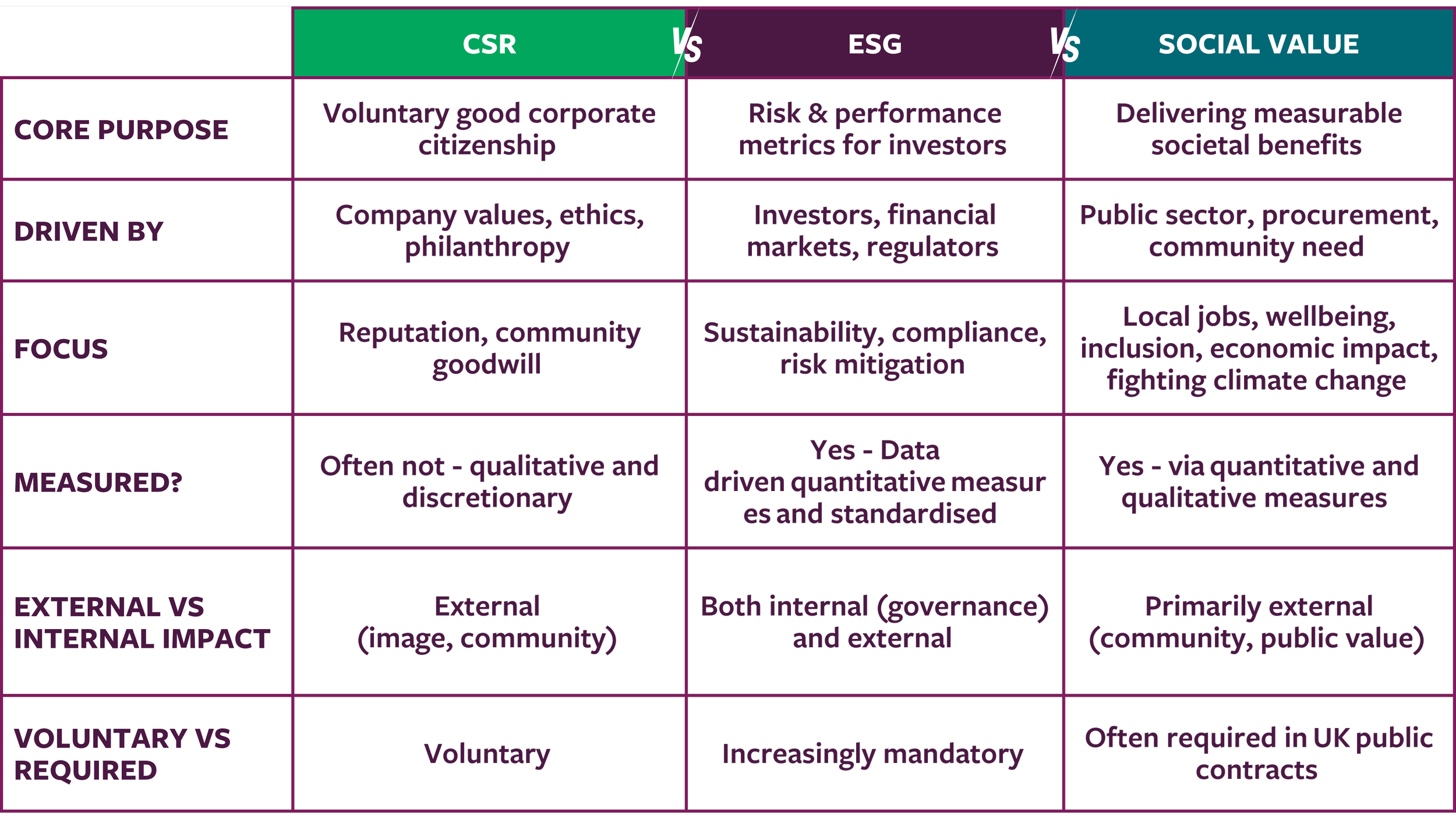
Table of comparison, CSR, ESG, Social Value
Final Thoughts
Here’s a simple way to think about it:
CSR = “We want to do good”
ESG = “We manage and report risks and opportunities”
Social Value = “We must prove we’re improving society, especially in this contract/project”
Each approach has its place, but they serve different purposes and different audiences. If you're working closely with the public sector or delivering services that affect people and places, then Social Value is likely the most relevant for you.
If you’re here because you're interested in Social Value, we’d love to help. Get in touch to find out how we can support your organisation in delivering meaningful impact.