

The New Social Value Model Has Arrived.
The Guidance Hasn't.
Here's What we Know, What we Don’t Know, and What that Means for Suppliers.
Introduction
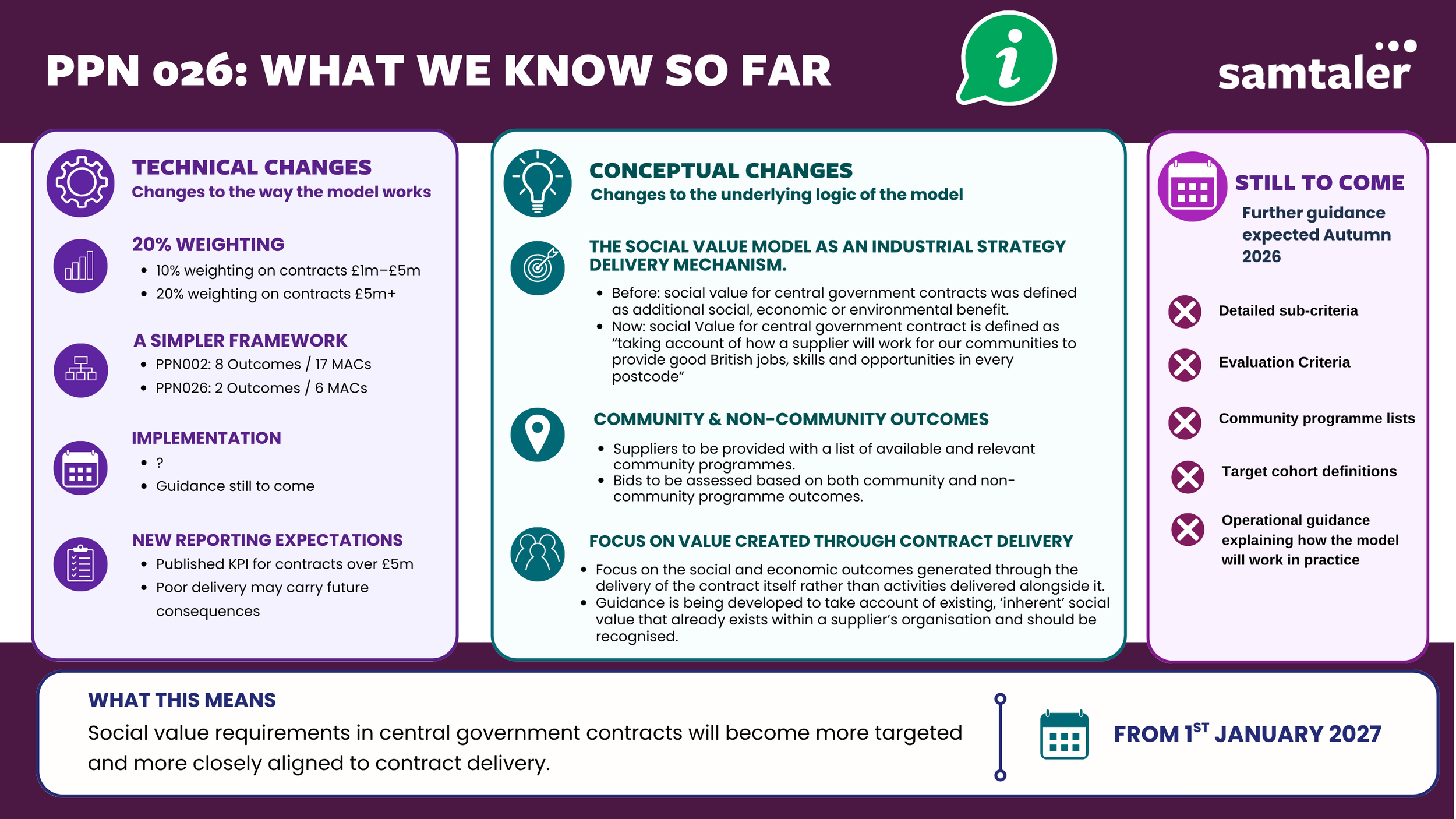
On 5 August 2026, the Government published PPN026, a completely revised Social Value Model focused on jobs, skills and economic opportunity. We now know the broad direction of travel. What we do not yet have is the supporting guidance that will determine how the model works in practice.
For organisations bidding for public contracts, understanding the difference between what we know and what we do not know could be the difference between preparing effectively and heading in the wrong direction.
What We Know
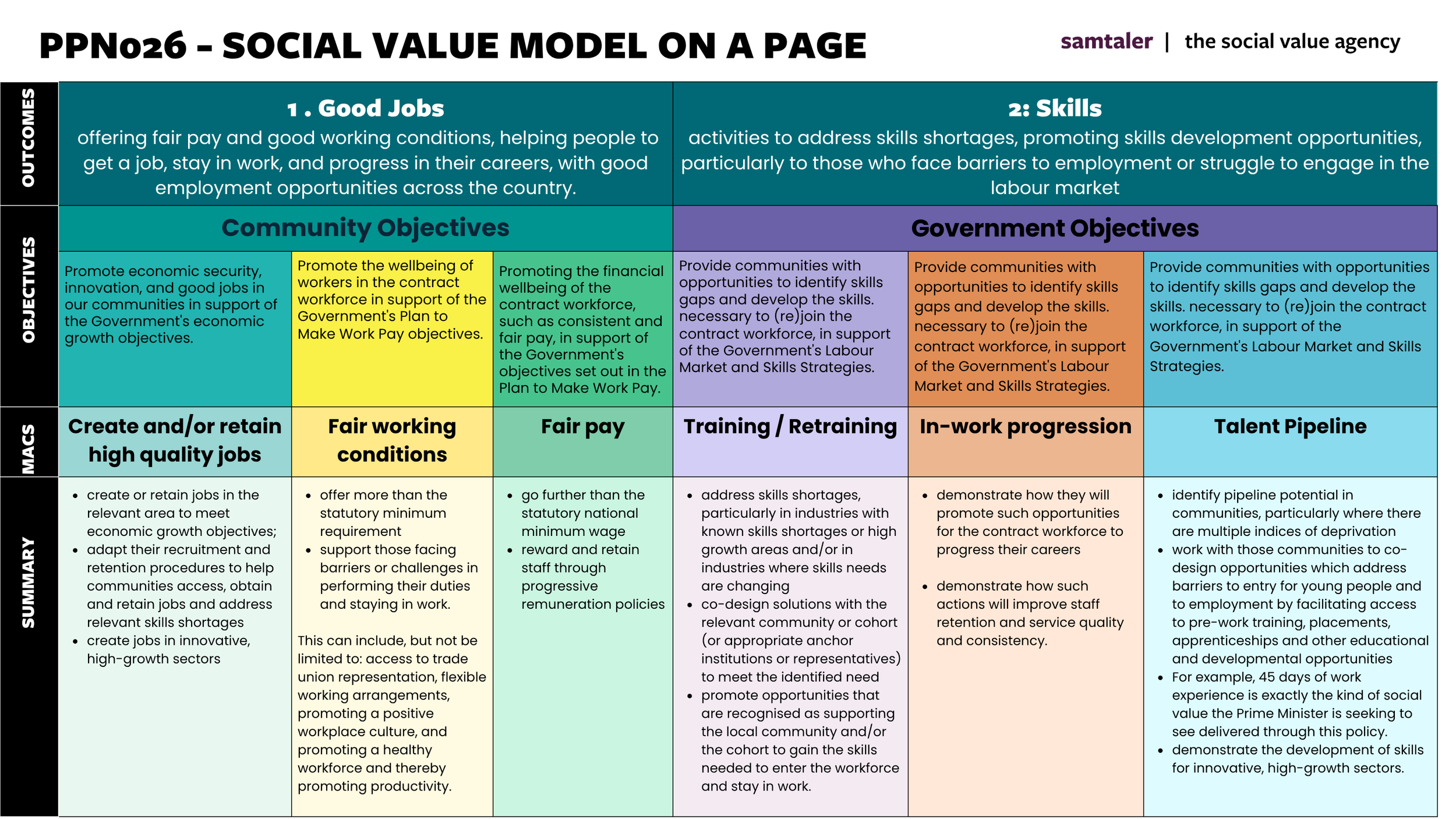
The Social Value Model has been dramatically streamlined. The previous model contained multiple missions, outcomes, MACs and reporting requirements. PPN026 reduces this to two: Good Jobs and Skills.
Social Value has become part of labour market policy. The message is clear: Government now views social value primarily through the lens of participation in the labour market and economic opportunity. Whilst this might represent a much narrower definition of social value than previous models, by linking it to labour market outcomes and economic growth objectives, social value is no longer operating at the edge of government policy.
Social Value is becoming more commercially significant
In Central Government Procurement, contracts between £1 million and £5 million will carry a minimum social value weighting of 10%, while contracts worth £5 million or more will carry a minimum weighting of 20%. This makes it harder to ignore, as it will carry more influence on major contract awards.
The Model Applies From 1 January 2027
Buyers and Suppliers now have a transition period to prepare before the model becomes mandatory for new procurements.
What’s changed?
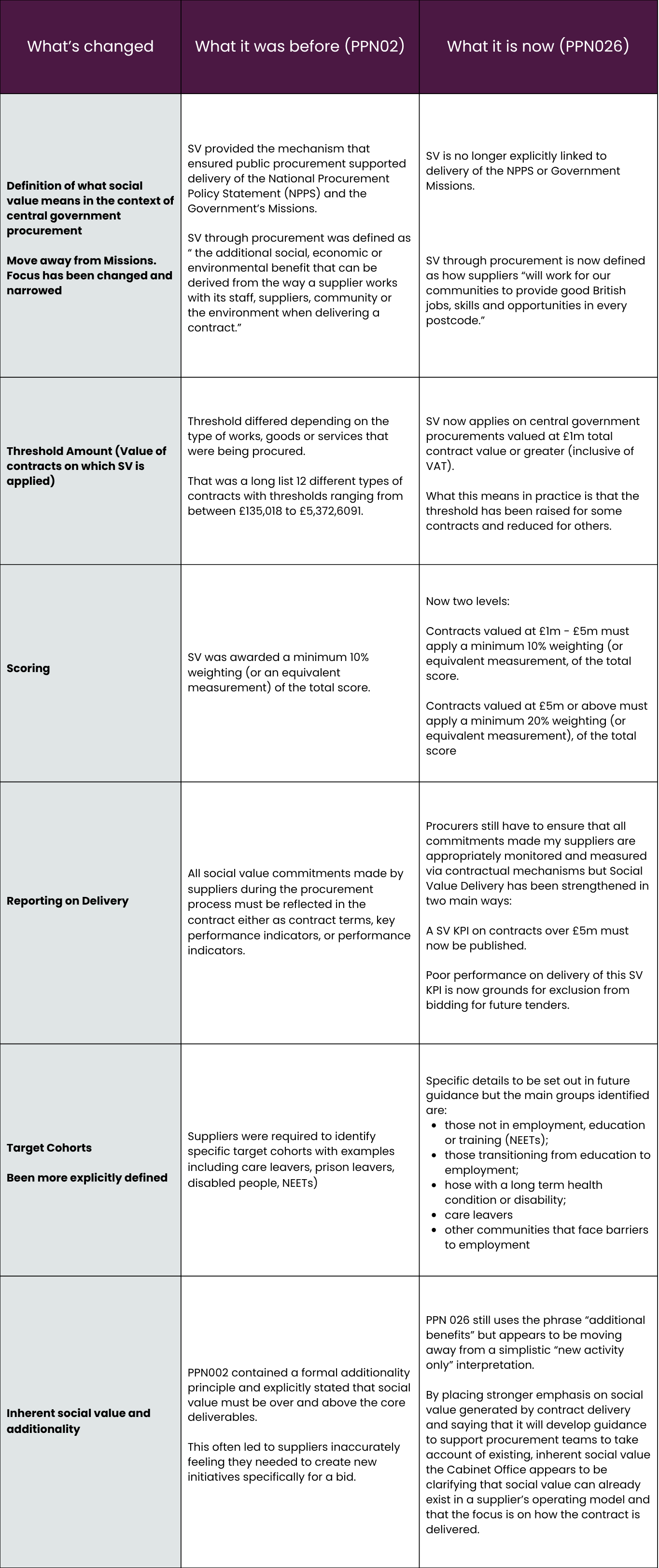
Here’s our summary of the main differences we can see so far between the old model (PPN002) and the new (PPN026):
Five new concepts hidden inside PPN026
PPN026 introduces several concepts that either did not exist in previous versions of the Social Value Model or were not previously given such prominence. While much of the attention has focused on the new outcomes and weightings, there are a number of potentially significant changes hidden within the new model that could have a major impact on how social value is designed, evaluated and delivered.
At this stage, however, we only have the headlines. The policy tells us the direction of travel, but much of the detail needed to understand how these new concepts will work in practice is still to come. The supporting guidance due later this year will be critical in explaining exactly what these changes mean for Buyers and Suppliers.
Community Objectives vs Government Objectives
The new model is structured around two headline outcomes, Jobs and Skills, which are then broken down into six award criteria. What is interesting is that some award criteria have been classified as Community Objectives and others as Government Objectives. The language suggests that the distinction is deliberate rather than accidental but until the supporting guidance is released we do not know what practical significance this distinction will have.
Community Programmes
For the first time, the model introduces the concept of community programmes that will sit alongside the selected outcome and MACs. The Government has confirmed that further guidance will include a list of relevant community programmes, but the detail is yet to be published.
Based on what’s been issued so far, our best guess is that Community programmes could become the mechanism that connects procurement activity to local labour market needs, with Suppliers given a list of community programmes and able to choose whether or not to deliver against one of these programmes or deliver their own initiatives. This raises several questions. Will they be nationally prescribed? Will Buyers be able to define local programmes? How much freedom will Suppliers have to propose their own interventions?
Depending on the answers, community programmes could become the mechanism that links procurement activity much more directly to local labour market needs.
Existing or Inherent Social Value
The Government has indicated that future guidance will explain how contracting authorities can take account of existing or inherent social value. This has the potential to be one of the most significant changes in the entire model.
Historically, many Suppliers have felt that social value needed to be something additional that was created specifically for a contract. Whether that interpretation was always correct is open to debate, but it has undoubtedly shaped behaviour across the market.
PPN 026 suggests there may be greater recognition of activities that already exist within an organisation, such as apprenticeship programmes, local recruitment practices, workforce development pathways and employee wellbeing initiatives.
The key question is what this will mean in practice. Will Buyers be encouraged to recognise and reward good employment and workforce practices that are already embedded within a Supplier's operating model? And can the sector move away from viewing social value as an add-on to a contract and instead see it as something that is created through the way a contract is delivered?
If that is the Government's intention, it would represent a significant shift in thinking and could fundamentally change the conversation around what good social value looks like.
From employability to In-Work Progression
Although the concept existed in the previous model, PPN 026 gives much greater prominence to in-work progression. Previous models focused heavily on helping people access employment opportunities but PPN 026 goes further by asking how Suppliers will help people progress once they are in work by developing new skills and moving into more secure, higher-value roles.
This would represent an important evolution in the social value agenda, moving the focus beyond employability and towards longer-term economic mobility and workforce development.
Fair Pay as a more important Social Value Outcome
Fair pay was introduced as a feature of social value in PPN002, yet remained very much a side issue. In the new model, Fair Pay has a much greater emphasis, appearing as a standalone MAC within the Good Jobs outcome. This could have wider implications than many Suppliers initially anticipate, as it may require a level of transparency around pay practices that some organisations are not currently prepared for, creating both practical and cultural challenges for bid teams and business leaders.
The biggest mistake right now? Assuming we have the full picture
We don't. What has been published so far sets out the framework, but much of the detail is still to come. Before drawing firm conclusions, it is worth remembering that there are still several major unanswered questions. Here are eight of the most important:
1) What the Community Programmes actually are.
The model introduces the concept of community programmes but says no more than that about them so we don’t yet know:
What activities will qualify? Will there be nationally prescribed programmes or will they link to programmes already in existence?
Will Suppliers have flexibility if will they be expected to deliver them exactly as designed?
How much of the score will be linked to community programmes versus other social value activity; and
Will supporting an approved programme score more highly than proposing your own initiative?
2) When exactly will more details be released?
What we know is that detailed guidance will be published in Autumn 2026. That can normally mean any time up until Christmas but with the new Social Value Model due to come into force on 1 January 2027, we expect guidance will be released by October 2026 at the latest. But don’t quote us because we don’t know for sure!
3) What ‘in every postcode’ means and how it will be applied.
The Model says new guidance, when it comes, will ‘reinforce the community focus of the model’ but we don’t know any more than that.
This will be particularly important for suppliers of central government contracts that aren’t being delivered in any one particular location.
4) Whether Buyers can develop/add policy outcomes.
The previous model (PPN002) said that ‘where an in-scope organisation has an opportunity to contribute to the delivery of specific objectives related to its own strategy and operations, additional policy outcomes may be added. However, this must not be instead of applying the model’.
We very much hope (but don’t yet know) that this will continue under the new model. If it does, we wouldn’t be surprised to see Departments creating their own additional outcomes to expand the scope to suit their own objectives and operations.
5) How will local government respond?
At this stage, we simply don't know. The new Social Value Model applies to central government and other in-scope organisations, but Local Authorities are not required to use it. They are free to adopt elements of the model or align their own approaches with it if they choose but whether they will depends on a range of factors, including local priorities, existing social value frameworks, political leadership and regional economic objectives.
It is certainly possible that some local authorities, combined authorities and emerging regional bodies could choose to align their procurement strategies more closely with the new focus on jobs, skills and workforce development. However, until we see how procurement strategies evolve over the coming months, any prediction would be speculative. For now, the safest assumption is that local authorities will continue to develop their own approaches, while keeping a close eye on how the new central government model is implemented.
6) What will the detailed sub criteria look like?
At the moment, we only have the headlines. The real detail, including the sub-criteria that suppliers will be assessed against, is still to come in the supporting guidance.
Although the requirements aren’t particularly new, until the sub-criteria are published, we will know the broad outcomes the Government wants to achieve, but won’t know the full detail of what Suppliers will be expected to do in order to score well.
7) How social value will be evaluated
One of the biggest unanswered questions is how social value responses will actually be assessed and scored. The policy refers to a new evaluation methodology, which suggests there may be changes to the way social value is assessed, but there are still a lot of unknowns.
Until the supporting guidance is released, suppliers know broadly what outcomes the Government wants to see, but not exactly how those outcomes will be measured or evaluated in practice.
8) How the model will work in practice
The new model feels significantly different from its predecessors, which means the supporting guidance is likely to play a much bigger role in determining how it operates in practice.
In reality, there was relatively little difference in how PPN06/20 and PPN002 were applied on the ground. PPN026 feels different. The shift in focus, the introduction of community programmes and the move towards jobs, skills and workforce outcomes raise a number of practical questions that have yet to be answered.
At Samtaler, some of the questions we are watching most closely include:
What happens where the model is not relevant or proportionate?
The PPN states that the model should be applied where a model award criterion is relevant to the subject matter of the contract, proportionate, and does not create unnecessary burdens or barriers to participation. However, it does not currently explain what a contracting authority should do if it concludes that none of the available criteria are relevant or proportionate to a particular procurement. Given the much narrower focus of the new model, this feels like a significant gap that the supporting guidance will need to address.
How will the model operate within framework agreements?
The policy confirms that social value should be assessed at both framework and call-off level, with further guidance to follow. However, many of the practical details remain unclear. How will thresholds be applied? Will Suppliers need to make commitments at both stages? How will duplication be avoided? Given the volume of public sector procurement delivered through frameworks, the answers to these questions could have significant implications for both Buyers and Suppliers.
Ultimately, we know where the Government wants to get to. What we do not yet know is how many of these practical issues will be resolved once the detailed guidance is published.
What does this mean for suppliers to the public sector?
While most of the details are still to come, suppliers should not mistake a simpler model for a less important one. Social value remains firmly on the agenda. The difference is that the Government is becoming much more specific about the outcomes it wants to see, particularly around jobs, skills and opportunities for communities.
Many suppliers will need to rethink how they approach workforce development, recruitment and skills
Perhaps the biggest question for Suppliers is not whether they understand PPN 026, but whether they are genuinely equipped to deliver the outcomes it prioritises.
Over the last few years, many organisations have built mature social value programmes centred around volunteering, school engagement, fundraising and community projects. Those activities remain valuable, but they are no longer the primary focus of the model. PPN026 shifts the conversation towards workforce planning, recruitment, retention, skills development, in-work progression and helping more people access and succeed in employment.
The themes themselves are not new. Employment, skills and workforce development have featured in previous versions of the Social Value Model. What has changed is the level of emphasis being placed on them. By narrowing the scope of the model and increasing the weighting available, the Government has made these issues much more difficult to ignore.
This presents a practical challenge for many Suppliers because responsibility for these areas often sits outside traditional social value teams. The people who may now be most important to social value delivery are those working in HR, recruitment, workforce planning, learning and development, apprenticeships and early careers. Social value is becoming less of a standalone activity and more of an organisational capability embedded within the way a business operates.
Success under PPN026 may depend less on writing a strong bid response and more on demonstrating that an organisation can genuinely create jobs, improve working conditions, support progression and address skills shortages through contract delivery. That is a fundamentally different challenge from simply learning a new set of award criteria.
The reality is that many Suppliers are not currently structured to deliver the outcomes the Government is now seeking. In many organisations, recruitment, workforce development and progression have not historically been treated as strategic priorities, either at a corporate level or within individual contracts. We therefore expect to see a significant readiness gap across parts of the Supplier market.
This challenge is likely to be greatest for organisations whose social value activity has traditionally focused on charitable giving, volunteering and community engagement rather than jobs, workforce development and long-term progression. While those activities continue to have value, they are no longer at the centre of the model.
Many Suppliers are therefore starting from a long way behind. Organisations that have not invested in recruitment pathways, early careers programmes, workforce development and progression opportunities may find adapting to the new model particularly challenging.
The fact that social value can now account for up to 20% of an evaluation score sends a clear message about the direction of travel. The Government is placing jobs, skills and workforce outcomes much closer to the heart of procurement decision-making, and that is likely to drive significant changes in how Suppliers design, evidence and deliver their social value commitments.
For many organisations, the biggest challenge will not be understanding PPN 026. It will be developing the internal capability, systems and partnerships needed to deliver it successfully.
Supply chains and the environment
Much of the chatter amongst social value professionals, and many of the headlines you may have seen since the model was released, has been about the removal of supply chain diversity and environmental sustainability.
Interpreting the streamlining of the Social Value Model as a signal that these things are no longer important to the Government is a mistake; these issues remain important government priorities.
Whilst these areas have been moved out of the social value mechanism, in our view that is because they are already being addressed through other parts of the procurement framework. For example, support for SMEs and VCSEs is covered through PPN001, while environmental requirements are addressed through PPN006 and PPN016.
The overall expectation on Suppliers has not reduced. If anything, it has become more clearly defined, with different policy objectives being assessed through different mechanisms. In practice, the new Social Value Model narrows its focus to jobs, skills and opportunities, while the wider procurement framework continues to address environmental performance, carbon reduction, responsible supply chains and SME and VCSE participation.
Final Thought
PPN026 provides clarity on where Government wants to go. What it does not yet provide is complete clarity on how Buyers and Suppliers will get there.
The organisations that spend the next few months understanding the new concepts, assessing their existing capabilities and preparing for the unanswered questions will be in the strongest position when the model comes into force on 1 January 2027.
The biggest change in PPN026 may not be the reduction from multiple themes to two outcomes. It may be the redefinition of social value itself: from a broad set of community activities to a much sharper focus on jobs, skills, progression and economic participation.

Sarah Stone
Founder & CEO